The cottage shooting
Nieuwe burenThe cottage shooting is the novel’s decisive collision of grief, reproductive deception, and possessive violence. Peter arrives at a confrontation over Eva’s pregnancy and the way it was conceived; when Rebecca shoots him, he answers with gunfire that kills Rebecca, Steef, and Eva. He tries to die afterward, but Sem’s presence interrupts that choice and gives Peter a reason to remain alive.
Background: infertility and a concealed plan
The crisis grows out of Peter and Eva’s struggle to conceive. Their general practitioner initially dismisses their concern, reasoning that after a year of trying, many couples are still not pregnant, and recommends temperature tracking rather than immediate referral. Eva records her temperature every morning; when it rises, they have sex according to the likely timing of ovulation. The attempt to make conception measurable changes their sex life into a schedule, a strain that Peter eventually tells Eva he no longer wants to accept.
After a further argument, the couple sees a gynecologist. Eva’s examination, temperature charts, and ultrasound reveal no obvious reproductive problem, but two semen tests show that Peter has too few sperm and that they move poorly. The prospect of medical treatment sharpens the conflict between his wish for a child conceived through love and Eva’s overwhelming desire to become a mother. That history makes the later pregnancy more than a private surprise: it raises the question of whose reproductive choices were made, and whose consent was bypassed.
Eva and Rebecca plan to use partner-swapping to try to bring about a pregnancy. They intend to time the encounter for Eva’s next ovulation and, if the first attempt fails, to try again. When the condom is raised as an obstacle, Rebecca suggests that it could leak. The plan is not discussed with Peter or Steef. Its logic depends on a deliberate risk of conception, while leaving the men outside the decision that may make one of them a biological father.
The confrontation
The pregnancy’s possible consequences have already surfaced in Steef’s response to the condom accident. He brings Eva a Morning-after pill from a night pharmacy, says he accepts responsibility for what happened, and describes the intimacy between them as a bond rather than romantic love. He also says he does not want another child: Sem was conceived against his will, and Steef considers himself too unstable and too attached to his freedom to be a father again. His later fury at the cottage therefore comes from more than surprise. He understands the pregnancy as the result of a choice made about his body without his knowledge.
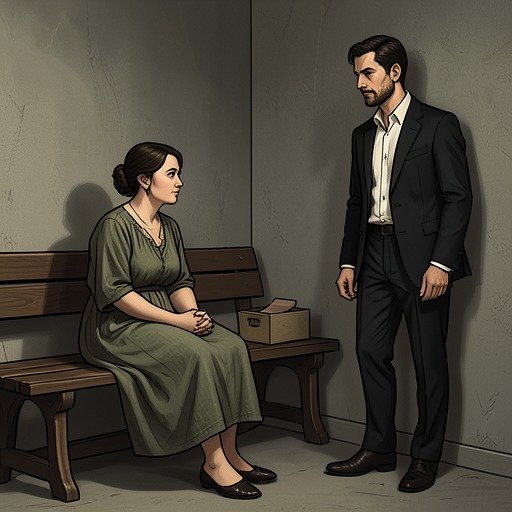
When Steef learns what Eva and Rebecca arranged, he calls it the theft of his semen and condemns both women for deciding that they could dispose of him in this way. He insists that he does not want the child and invokes the importance of a father, drawing on his own conflicted experience of raising Sem. His anger makes explicit the reproductive wrong at the center of the confrontation: the pregnancy is bound up with a concealed plan, not with a shared agreement about parenthood.
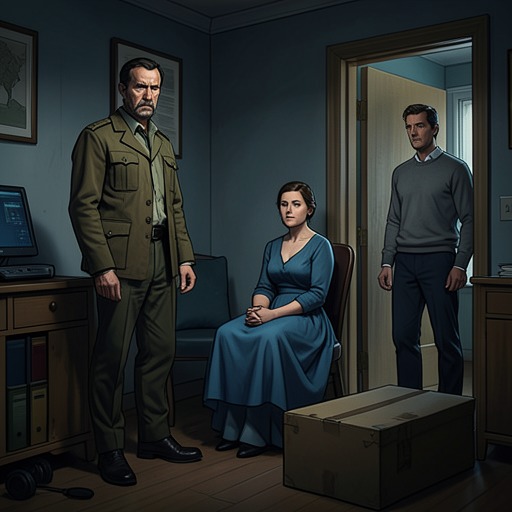
Peter sees Steef cowering and hears Eva say that she and Peter are having a child. The claim reaches him at the point where he is already armed and overwhelmed by what he has learned. When he prepares to pull the trigger, the image of Lieve dead in the hospital returns to him. He cannot shoot while a child is involved. The memory briefly interrupts the violence, but it does not dissolve the danger in the room.
The shooting
A shot rings out and wounds Peter in the flank. He sees Rebecca in the doorway, gripping the weapon, and blood pours from his side. He says he fires because he believes she will shoot again and he has to protect himself. Rebecca falls; Eva runs to her and drags her to the sofa. The scene shifts from a confrontation over who may claim the child to a struggle in which Peter experiences the people around him as an undifferentiated mass of noise and threat.
Peter swings his pistol toward Steef, who springs at his hands. Peter fires again, and Steef collapses against the wall. Eva screams. When Peter turns toward her, he describes the choice as a contest between her and himself and says he cannot remain alone. Eva fires too, but her bullet strikes the ceiling; Peter’s shot hits her heart. She falls across Rebecca’s body. The sequence leaves all three of them shot by Peter, with Rebecca’s initial shot having wounded him and Eva’s return shot missing him.
Sem and the aftermath
After the room goes quiet, Peter collapses and points the barrel toward his own heart. He cannot lift his hand high enough to finish the act. As the guitars fall silent and his pain continues, he begins to cry; then he hears a child crying in the corner of the kitchen. Sem is hidden beneath the counter, clutching his stuffed rabbit. The discovery changes the meaning of Peter’s failed suicide attempt: he understands that the child has witnessed what he has done, and that he will have to live with Sem’s frightened eyes and atone for the killings.
Peter tries to reach for Sem and then for his mobile phone, but the wound makes movement painful. He apologizes. Sem puts his pacifier in his mouth and stares at Peter, while Peter slips away into the cold. The passage does not establish Peter’s recovery; it ends with his resolve to live for Sem set against his physical collapse.
Significance
The shooting brings the novel’s disputes over infertility, genetic parenthood, and consent into the same confined space as Peter’s bereavement and fear. Peter’s infertility makes the pregnancy especially charged, but the evidence does not settle every question of biological paternity in the confrontation itself. Instead, Steef’s accusation exposes how Eva and Rebecca’s plan assigned consequences to him without his agreement, while Eva’s assurance to Peter places the hoped-for child within their marriage. The competing claims cannot be reconciled before violence takes over.
The event also turns on two interruptions. The memory of Lieve prevents Peter from firing at Steef when he first has the chance; Sem’s crying later prevents Peter from completing his suicide. Children, absent and present, mark the limits Peter briefly recognizes and then the responsibility he cannot escape. His survival is not presented as absolution: he understands it as punishment and obligation, a life he must continue for Sem after destroying Sem’s family.